



How to Heal a Tattoo Day by Day
A fresh tattoo is, for all intents and purposes, a wound in the skin. What you do in the following weeks affects how the ink settles and how the finished work looks. The good news is that the aftercare is simple: gentle cleaning, a thin layer of cream, patience and common sense.
This guide sums up, stage by stage, the most widely accepted aftercare for healing a tattoo. First of all, a warning that applies to the whole text: always follow your tattoo artist's instructions. Every professional works with their own protocol, and they know your tattoo, the area and the technique used. This guide is for general guidance only and does not replace their judgement or a doctor's.
Before you start: the basics for the whole process
- Clean hands. Always wash your hands before touching the tattoo.
- Mild soap and lukewarm water. Wash gently, without sponges or exfoliating gloves.
- Pat dry. Use clean kitchen roll or gauze, without rubbing.
- A thin layer of cream. The skin should be cared for, not soaked. Too much product does not help.
- No scratching or picking. Neither scabs nor peeling skin.
- Loose clothing. Avoid constant rubbing from seams, belts or straps on the area.
- No sun, swimming pools, sea, sauna or long baths until the tattoo has healed.
The first hours: leaving the studio
When the tattoo is finished, your tattoo artist will clean the area and cover it with cling film or a dressing. Some studios apply a finishing gel first; for example, the Proton Photo Finish sheet says to apply a thin layer to the freshly finished tattoo and cover it with film or let it air dry, according to the professional's protocol.
Keep the covering on for as long as your tattoo artist has told you. When it is time to take it off:
- Wash your hands.
- Remove the film or dressing carefully. If it is stuck, wet it with lukewarm water so it comes away.
- Wash the tattoo with lukewarm water and mild soap, using your fingertips, to remove ink, plasma and cream residue.
- Pat dry with clean paper and let the skin breathe for a few minutes.
- Apply a thin layer of aftercare cream.
It is normal for the tattoo to be red, a little swollen and warm to the touch, and to release a little ink and clear fluid.
Days 1 to 3: cleaning and moisturising
These are the days when the tattoo is most sensitive. The most common routine is to wash the area two or three times a day, pat it dry and apply a thin layer of cream, or as often as your tattoo artist tells you.
During these days:
- Sleep in clean cotton clothing and, if you can, avoid putting your weight on the tattoo.
- If your clothes stick to the skin in the morning, wet them before taking them off. Do not pull.
- Avoid intense exercise, heavy sweating and dusty or dirty environments.
- Keep showers short and lukewarm. Do not submerge the tattoo.
What cream should I use on a new tattoo?
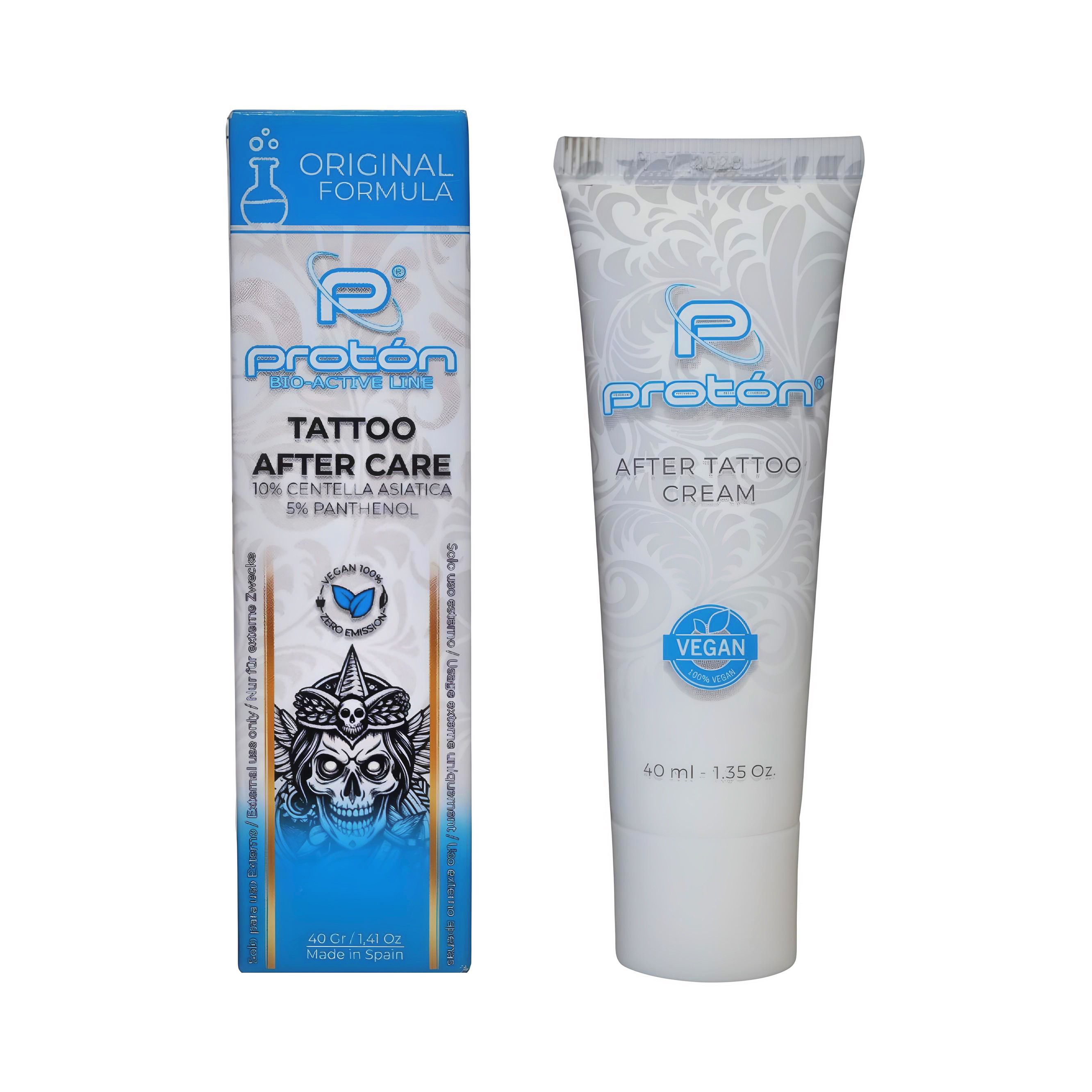
Use the cream or butter your tattoo artist recommends. Proton butters are 100% natural and can also be used at home (more on this below). If you are looking for a cream made specifically for tattooed skin, Tattoo Proton makes Proton Tattoo Original After Care 40 ml, developed to support the care routine for tattooed skin. Its formula combines Centella asiatica and panthenol, with a texture that spreads in an even layer.
According to its sheet, use is simple: wash your hands and follow the cleaning routine indicated for the area, spread a thin layer according to the product's and your professional's instructions, and repeat as often as indicated, without overloading the area. Close the container after use so the contents do not get contaminated. The 40 ml size is designed to carry with you.
Days 4 to 14: itching, peeling and scabs
From the fourth or fifth day, the skin starts to renew itself. Peeling, like skin flaking off, is normal, and small thin scabs may appear in some areas. Itching is also very common.
- Do not scratch. If the itching bothers you, gentle tapping with a clean hand or a thin layer of cream usually helps.
- Do not pick off peeling skin or scabs. If you lift them too early, you can pull out ink and leave lighter patches.
- Keep up the routine of gentle washing and a thin layer of cream, without overdoing it.
- Keep wearing loose clothing and avoid constant rubbing.
- Still no sun, swimming pools, sea or sauna.
In this phase the tattoo may look dull or have a milky film over it. This is part of the process and usually disappears once the skin has finished renewing.
Weeks 3 and 4: the skin settles
The surface layer is usually closed by now, but the skin is still recovering underneath. The tattoo may look a little shiny or slightly different in tone from how it will end up.
- Keep moisturising if your skin needs it.
- Gradually go back to the pool, the sea or the gym once your tattoo artist confirms it has healed.
Sun after healing
Sun is one of the factors that most affects how a tattoo looks over time. While the tattoo is fresh, keep it out of the sun: the Proton Tattoo Solar SPF 50 After Care sheet itself warns about this, and points out that sunscreen does not replace that precaution.
Once healed, this sunscreen adds SPF 50 to the care of tattooed skin, with Centella asiatica and panthenol. Apply the amount indicated on the label and reapply according to its instructions, especially after sweating or swimming. No sunscreen provides total protection.
Tattoo butter and Vaseline: can you use them for healing?
It is a common question. Proton butters, such as EVOLUTION Process Butter, are 100% natural. Tattoo artists use them during the session, but they can also be used at home during healing to keep the skin moisturised: apply a very thin layer after each wash, without overloading the area. ORIGINS Vaselina Filante SD58, on the other hand, is a product for studio work.
In any case, use what your tattoo artist recommends: a butter or a dedicated aftercare cream. You can see the range of session products in soaps and butters, and aftercare products in tattoo and piercing aftercare.
If you ever have laser removal sessions, the aftercare is different: Proton has a specific format, Proton Tattoo Laser After Care, which should always be used following the instructions of the healthcare professional carrying out the treatment.
When to see a doctor
Mild redness and some swelling in the first few days are normal. But see a doctor if you notice any of these signs:
- Pain that gets worse over the days instead of easing.
- Swelling, heat or redness spreading beyond the tattoo.
- Pus, a bad smell or yellowish or greenish discharge.
- Fever or feeling generally unwell.
- Hives, blisters or intense itching that does not ease, which may indicate a reaction.
Let your tattoo artist know too, but do not wait to speak to them before seeing a healthcare professional if these symptoms appear.
Frequently asked questions
How long does a tattoo take to heal?
As a rough guide, the surface usually closes in about two to four weeks, and the skin finishes settling in the weeks after that. It depends on the area, the size, the technique and each person's skin. Your tattoo artist will tell you when they consider it healed.
How many times a day should I put cream on a tattoo?
As many times as your tattoo artist or the product label says, always in a thin layer and without overloading the area. The usual approach is after each wash.
Can I shower with a new tattoo?
Yes, with short, lukewarm showers, without submerging the tattoo or letting the water jet hit it directly. Afterwards, pat dry and apply the cream.
Can I go to the beach or the pool with a new tattoo?
Not until it has healed. Avoid the sun, the sea, swimming pools and the sauna. Once it has healed, protect it from the sun with a sunscreen for tattooed skin.
Is it normal for a tattoo to peel?
Yes. Between the fourth day and the second week, it is common for the skin to flake and itch. Do not pick off the peeling skin or scratch: let it fall off on its own.